 Harmoni
A student once played me C, F, G, C. Three chords, the backbone of a thousand songs. His right hand was hopping across the keyboard like a kangaroo, every chord in root position, exactly as the method book showed. It was correct. It also sounded like a choir changing seats every bar. He was missing one idea: piano chord inversions. Inverting a chord means keeping the same notes and changing which one sits at the bottom. C-E-G becomes E-G-C or G-C-E. Same chord, same name, different color, and above all a hand that barely has to move.
Inversions often get taught as a theory box to tick. That undersells them. They are the tool that turns a list of block chords into connected music. Here is how to build them, how to name them, how to pick the right one by ear, and four drills to get them into your fingers this week.
What is a chord inversion on piano?
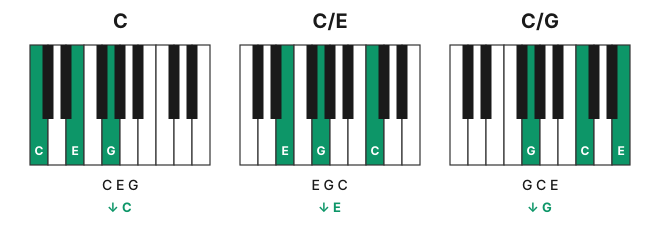
Start with a triad in root position: root on the bottom, then the third, then the fifth. C-E-G. Move the C up an octave and you get E-G-C, the first inversion, with the third in the bass. Do it again with the E: G-C-E, the second inversion, fifth in the bass. Move the G up and you are back to C-E-G, an octave higher. So a triad has two inversions, and the general rule is easy to remember: a chord with n notes has n minus 1 inversions.
You will meet two ways of writing them. Pop and jazz charts use slash chords: C/E means "C major with E in the bass", so first inversion, and C/G is second inversion. Classical theory uses figured bass: a first-inversion triad is a 6 chord (or 6/3) and a second-inversion triad is a 6/4 chord, named after the intervals above the bass. The Wikipedia entry on inversion in music covers the full nomenclature if you are heading into an exam.
The key point: the chord's function does not change. C/E is still the tonic chord in C major. What changes is how stable it feels and the bass line it draws.
How do you invert a seventh chord?
Four notes, so three inversions. With Cmaj7 (C-E-G-B):
| Position | Notes (low to high) | Slash | Figured bass |
|---|---|---|---|
| Root position | C, E, G, B | Cmaj7 | 7 |
| First inversion | E, G, B, C | Cmaj7/E | 6/5 |
| Second inversion | G, B, C, E | Cmaj7/G | 4/3 |
| Third inversion | B, C, E, G | Cmaj7/B | 4/2 (or 2) |
Third inversion is the spiciest: the seventh in the bass rubs a half step against the root right above it. On a dominant seventh (G7/F), that bass seventh badly wants to step down, to the E of C/E. Bach uses that move constantly in his chorales, and you will hear the exact same motion in pop ballads. musictheory.net has a clean interactive lesson on seventh chord inversion if you want to drill the figures.
Why do inversions make chord changes smoother?
Back to C, F, G, C. All in root position, the right hand jumps up a fourth to F-A-C, up a step to G-B-D, then down a fifth. Three whole-hand moves. Now with inversions:
| Chord | Low voice | Middle voice | Top voice |
|---|---|---|---|
| C | C | E | G |
| F/C | C | F | A |
| G/B | B | D | G |
| C | C | E | G |
Read each column top to bottom. The low voice goes C, C, B, C: a half-step neighbor figure. The top voice goes G, A, G, G. No voice moves more than a minor third, most move a half or whole step, and the C shared by C and F/C simply stays put. The hand never leaves its spot. That is the whole idea behind voice leading: keep the common tones, move everything else the shortest way.
My take, and I stand by it: drilling chords only in root position for months is the worst habit beginner methods pass on. It produces pianists who know their chords but cannot connect them. Inversions should show up in week three, alongside the chords themselves.
Which inversion should you choose, and how do they sound?
Each position has a personality. Root position sounds settled and final, the end-of-song chord. First inversion is lighter and sounds like it is going somewhere, perfect mid-phrase. Second inversion is the least stable. In classical music it shows up mostly as the cadential 6/4 (C/G before G7 and then C), where it acts like a suspension holding back the resolution.
The second criterion is the bass line. With C, G/B, then Am, the bass walks down C, B, A while the harmony stays perfectly ordinary. Countless ballads lean on that kind of stepwise bass, and inversions make it possible without changing a single chord on the chart.
The third criterion gets forgotten: the top note. In a right-hand-only progression, the highest note is the one your ear follows as a melody. Choosing an inversion means choosing an inner melody. Jazz pianists think this way all the time. The two voicing shapes Bill Evans made famous on Dm9, F-A-C-E and C-E-F-A, are nothing more than two inversions of the same four notes. Alternating them keeps the hand in the middle of the keyboard through a whole ii-V-I, as we explain in the piece on rootless voicings.
Four drills to master chord inversions this week
1. The staircase. Play C major in root position, first inversion, second inversion, then root position an octave up. Climb two octaves and come back down, saying the bass note out loud. Cover all twelve keys over a week, two a day. Naming the bass aloud feels silly. It works.
2. Shortest path. Take two chords, say Am and Dm. Start Am in any position and find the Dm inversion that sits closest, the one that keeps the shared note (A) and moves the least. Then go back. Repeat from a new starting position.
3. The connected chart. Take a progression you know cold, Let It Be, Autumn Leaves or a plain I-vi-IV-V, and play it with the right hand without ever moving more than a third between chords. No cheating: if you jump, find another inversion.
4. The top line. Replay the same chart, this time choosing inversions so the top note traces a rising line, then a falling one. You just wrote your first arrangement.
How HarmoniKeys helps you practice inversions
Finding the best inversion by hand, chord after chord, is slow at first, and that is fine. HarmoniKeys runs that calculation across a whole progression: the app works out the optimal voice leading, with every chord in close position and in the inversion that keeps movement to a minimum. For each change it shows how many notes and how many fingers carry over from one chord to the next, along with left-hand and right-hand fingerings. Then the piano sound, loop mode and a metronome from 40 to 200 BPM let you repeat the progression until your hands own it. Preset progressions cover the common changes, and you can share your own with a student or bandmate by QR code.
Practice inversions at the keyboard
Download HarmoniKeys to practice these concepts at the piano: pick a progression, look at the inversions it suggests, then loop it with the metronome slowed down.
Open HarmoniKeysOnce inversions feel natural, the next step is to spread the voices out and let the chord breathe. That is the territory of drop 2 voicings, which are simply an inversion with one note dropped an octave. It all connects. And here is a question worth chasing next: on any given progression, how many different melodies can you hide in the top voice?