 Harmoni
Twelve bars. Three chords. More than a century of music built on top of them, from Chicago boogie-woogie to Charlie Parker's bebop heads. The 12-bar blues on piano is the first progression almost everyone learns, and very often the first one they play badly: three block chords in root position, a right hand jumping from A to D to E, and a result that sounds like a theory drill rather than the blues. The progression isn't the problem. The way the chords are connected is.
We'll start from the plainest version, in A, and then look inside the chords. Spoiler: two notes do almost all the work, and they never move more than a whole step.
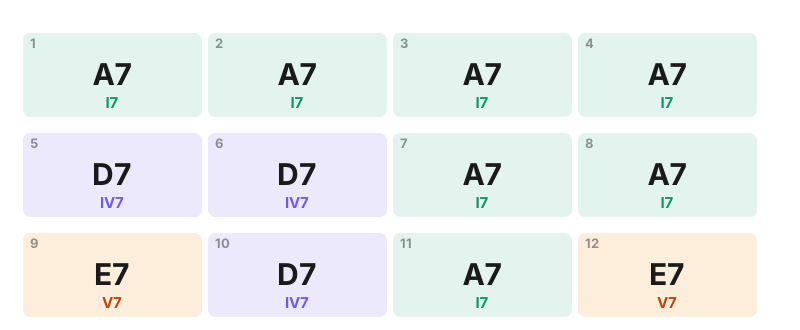
What is the 12-bar blues?
The 12-bar blues is a form: a twelve-bar cycle in 4/4, built on the I, IV and V chords of a key, repeated as many times as the tune needs. Each pass is called a chorus. In A, the chords are A7, D7 and E7. The standard layout fits in one sentence: four bars of I, two of IV, two of I, then one bar of V, one of IV and two of I (the very last bar is often swapped for the V to restart the loop).
That shape follows the lyrics. Sung blues uses AAB verses: a first line over bars 1 to 4, the same line repeated over bars 5 to 8 (but over the IV chord, which recolors it), and an answer over bars 9 to 12. When you play the changes without a singer, keep that breathing in mind. It's why bar 5 feels like a change of scenery.
W. C. Handy didn't invent the form, but his published sheet music, including St. Louis Blues in 1914, helped set it down on paper. Wikipedia's article on the twelve-bar blues covers that history and the many variants well.
Here's what surprises classically trained pianists: all three chords are dominant seventh chords. Even the tonic. In tonal harmony, an A7 "wants" to go to D. In the blues, it just sits there, at home, for four bars, resolving nothing. That's the sound of the style. Don't try to justify it with chorale rules. The blues has its own rules, and a seventh on the I chord is one of them.
Which blues progression should you play: basic, quick change, turnaround?
The chart above is the basic version. Two common tweaks make it come alive, and you'll hear them on most records.
The quick change moves to the IV chord in bar 2: A7, D7, A7, A7. The chorus opens with a quick round trip that previews bar 5. It breaks up the long stretch of I and adds motion right away. The turnaround lives in the last two bars. In its simplest form, you play E7 in bar 12 instead of staying on A7, so you land back on the I at the top of the next chorus. Richer versions run A7, F#7, B7, E7 (I, VI, II, V) through bars 11 and 12, and at that point you're already in jazz territory.
| Bars | Basic | With quick change |
|---|---|---|
| 1 to 4 | A7, A7, A7, A7 | A7, D7, A7, A7 |
| 5 to 8 | D7, D7, A7, A7 | D7, D7, A7, A7 |
| 9 to 12 | E7, D7, A7, E7 | E7, D7, A7, E7 |
My advice: learn the basic version until you can play it with your eyes closed, then switch to the quick change and never look back. Two weeks in, the version without it will feel stiff.
Why do three seventh chords sound so good together?
This is the part beginner books skip, and it's the part that changes everything. In a dominant seventh chord, two notes define the chord: the third and the seventh. These are the guide tones. Together they form a tritone, the most tense interval in the scale, and that tritone is what gives the blues its grit.
Watch what they do from chord to chord. On A7, the guide tones are C# (third) and G (seventh). On D7, they're F# (third) and C (seventh). Going from A7 to D7, G slides down a half step to F#, and C# slides down a half step to C. Two half steps. Nothing else essential moves. Same thing toward E7: G moves up to G#, C# moves up to D. Two half steps again.
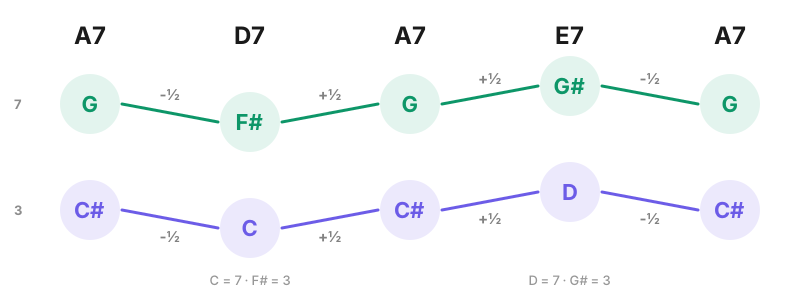
Notice the role swap too. G, the seventh of A7, moves to F#, the third of D7. C#, the third of A7, moves to C, the seventh of D7. The two voices trade jobs without ever crossing under your hand. That's voice leading in its purest form, and it's why a three-chord progression can run for ten minutes without getting old.
How to play the 12-bar blues on piano, hand by hand
Here's a four-step practice plan. Loop each step through the whole form before moving on.
1. Bass and guide tones. Left hand: just the root, one whole note per bar (A, D, E). Right hand: only the two guide tones, C# and G on A7, C and F# on D7, D and G# on E7. Take your time and hear every half step. It already sounds like the blues, with four notes in total.
2. Left-hand shells. Give the left hand the root plus a single guide tone: A and G for A7, D and F# for D7, E and D for E7. These are shell voicings, and they free your right hand entirely for melody. By alternating root-seventh and root-third shapes, your left hand stays within one octave.
3. The shuffle. The blues is almost never played with straight eighths. Think in triplets: each beat splits into three, and you play the first and third parts. Long, short. Long, short. Put your left-hand chords on beats 2 and 4, like a drummer's hi-hat, and the form starts to groove.
4. Move it to F and B flat. A is a guitarist's key. Jazz players mostly play the blues in F and B flat, thanks to the horns. Redo steps 1 and 2 in F (F7, Bb7, C7) and then in B flat (Bb7, Eb7, F7). The half-step pattern is identical. Only the keys change.
Once those four steps are solid, the natural next move is a walking bass in the left hand, which keeps the blues rolling without a bass player.
From the basic blues to Charlie Parker's blues
Jazz musicians kept the twelve-bar shape and rewrote the inside. A jazz blues in F, the way it's called at jam sessions, goes like this: F7, Bb7, F7, Cm7 F7, Bb7, Bdim7, F7, D7, Gm7, C7, F7 D7, Gm7 C7. The two extra chords in bar 4 make a ii-V into Bb7. Bars 9 and 10 replace V-IV with a ii-V that leads home to the I. Listen to Billie's Bounce, which Charlie Parker recorded in 1945, or Blue Monk, Thelonious Monk's B flat blues: same form, different clothes.
Parker went further with Blues for Alice, recorded in August 1951. The changes walk down through a chain of ii-Vs, to the point that people now call them "Bird changes." The Wikipedia page on Blues for Alice lays out the progression. The striking part is that the guide tones keep descending by half steps through most of the form. The principle you practiced on A7 and D7 is exactly what holds Parker's version together.
Strong opinion: don't tackle Bird changes until you can play a basic blues in three keys with guide tones. Without that foundation, Parker's changes stay a list of chords to memorize. With it, they become a line that falls.
Practicing the 12-bar blues with HarmoniKeys
HarmoniKeys includes a preset progression labeled "Blues 12 mesures (A)" (preset names are in French): twelve dominant seventh chords in A, the basic form with the E7 turnaround in bar 12. The app works out the optimal voice leading for the progression, in close position, choosing the inversion of each chord that keeps movement to a minimum, and shows left-hand and right-hand fingerings. The piano sound and loop mode keep the twelve bars cycling while you practice. The metronome goes from 40 to 200 BPM: start slow, around 60, and climb in steps.
The app plays the changes, not the shuffle or the improvisation: adding the swing feel and the guide tones on top is your job. For the quick change, build your own version of the progression with D7 in bar 2, and share it by QR code with a practice partner.
Get the blues looping at the keyboard
Download HarmoniKeys to practice these concepts at the piano: loop the 12-bar blues preset, follow the suggested voice leading, then play your guide tones over it.
Open HarmoniKeysThe blues is a lab. Everything you learn on it, the shuffle, the guide tones, the inserted ii-Vs, shows up later in standards. Once Parker's changes are under your fingers, the next question asks itself: what happens if you replace the D7 in bar 8 with its tritone substitution?