 Harmoni
Play a C major scale. Now raise the F a half step, play F sharp instead, and run the scale again. You just heard the Lydian mode, and the whole difference comes down to that one note. Where the major scale sits still, almost polite, Lydian lifts off. It is the color of wonder, the sound that makes a film theme feel like looking up at the sky.
The Lydian mode on piano is fascinating precisely because it is both familiar and strange. Familiar, because it is nothing more than a tweaked major scale. Strange, because that raised fourth flips the entire mood. Let us look at where this sound comes from, why it floats the way it does, and how to actually play it and drop it into your own music tonight.
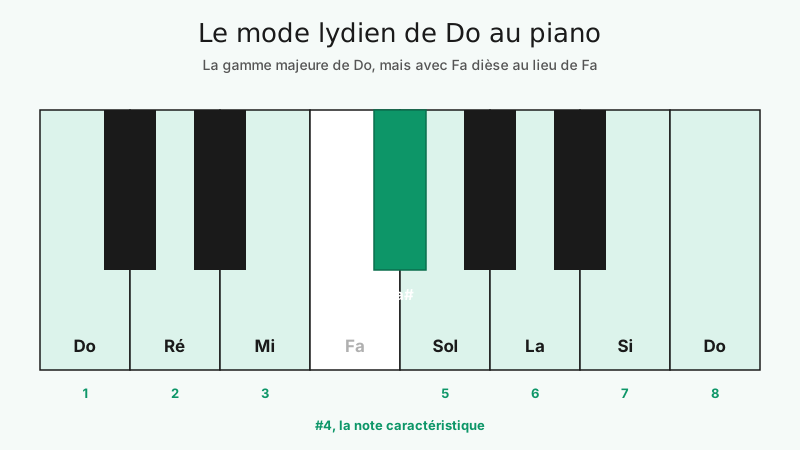
What exactly is the Lydian mode?
The Lydian mode is the fourth of the seven modes of the major scale. In practice, it starts on the fourth degree. Take the G major scale (G A B C D E F sharp), begin on C and play up to the next C: C D E F sharp G A B. That is C Lydian. Same keys as G major, but with C as the center of gravity.
There is a more useful way to see it at the keyboard: it is a major scale with a single change. C major is C D E F G A B. C Lydian is C D E F sharp G A B. One note raised a half step, the fourth one. We call it the raised fourth, or scale degree #4. It is the characteristic note of the mode, the one that has to ring out if you want people to hear Lydian and not just plain major.
Why does the Lydian mode sound brighter than major?
One note apart, and yet the effect is dramatic. The reason lives in the interval. Between the tonic and its F sharp there are three whole tones, a tritone. That interval, once nicknamed "diabolus in musica" in the Middle Ages, creates a tension that pulls upward. Instead of falling back toward the tonic the way a perfect fourth would, the raised fourth pushes the ear higher, toward openness. Hence that floating, rising feeling.
There is a second reason, more technical, and it matters directly to jazz pianists. Over a major chord, the perfect fourth (an F natural over a C chord) is what players call an "avoid note." It clashes with the major third and sounds off. Lydian solves this by swapping it for the raised fourth. The result: over a major chord you can play the whole Lydian scale and never land on a note that grinds. That is why many pianists treat Lydian, not Ionian, as the true sound of the major chord in jazz. Theorist George Russell built an entire method around it, the Lydian Chromatic Concept, which shaped Miles Davis and all of modal jazz.
The chord that embodies Lydian is the maj7 sharp 11. A Cmaj7#11, for example: C E G B plus that F sharp. Play it on the piano and let it ring. That suspended, slightly unreal color is Lydian squeezed into one chord. If you already work on altered chords on piano, the #11 is your doorway into the Lydian world.
Where have you already heard the Lydian mode?
Everywhere, really, especially at the movies. Film composers love Lydian because it says "wonder" without a word. The Simpsons theme, written by Danny Elfman, opens on a Lydian melody: that little climb that sounds slightly off yet magical is the F sharp. John Williams reaches for it to paint the fantastic, from the theme of E.T. to Yoda's motif in Star Wars, with that same scent of gentle mystery.
On the pop and rock side, "Dreams" by Fleetwood Mac bathes in a Lydian color, and so does "Every Little Thing She Does Is Magic" by The Police, whose title reads almost like an instruction manual. Frank Zappa turned it into a signature in his solos. Joe Satriani flat out named a track "Flying in a Blue Dream," built on the mode: the title describes exactly what the raised fourth feels like. Among classical writers, Bela Bartok leans on it in his "Music for Strings, Percussion and Celesta," and Debussy plays endlessly with these floating modal colors.
How do you play the Lydian mode on piano?
The hard part with Lydian is not the theory, it is making it sound. Running the scale up and down is not enough: it just sounds like G major starting on the wrong note. You have to anchor the ear on the right tonic and let the F sharp shine through.
Hold a drone in the left hand
The best exercise for hearing Lydian: hold the tonic in the left hand as a fifth. For C Lydian, plant C and G low and let them ring. Over the top, in the right hand, improvise freely with the notes of C Lydian (C D E F sharp G A B). As long as the bass holds C, every time you touch the F sharp the magic kicks in. It is the same logic as the modal improvisation of Kind of Blue: one chord that lasts, one scale, and you listen to the color.
Aim for the maj7 sharp 11 chord
For harmony, train your hands to grab the maj7#11 quickly. One elegant piano voicing: left hand on the root and seventh (C and B), right hand on E, F sharp and G. The F sharp sits right in the middle of the chord, so it sings without stinging. Move it through all 12 keys and the Lydian sound will be under your fingers.
Rock between two Lydian chords
A film-score cliche that never fails: two major chords a whole step apart, each played as Lydian. Cmaj7#11 to Dmaj7#11 and back, left hand swaying from C to D. You have heard that oscillation a thousand times in adventure films. It contains no dominant chord, no classical tension, just two Lydian colors answering each other.
Lydian, Ionian, Mixolydian: how to stop confusing them?
Three major-sounding modes look alike on paper and split apart on a single note. Ionian is the ordinary major scale, with a perfect fourth. Lydian raises that fourth (#4) and gains clarity. Mixolydian keeps the perfect fourth but lowers the seventh (b7), which makes it bluesy and dominant. A trained ear sorts them on that one pivot note. If you want the full picture of all seven colors, the guide to the modes of the major scale on piano lines them up, from brightest (Lydian) to darkest (Locrian).
One last landmark that helps a lot: sort the modes from brightest to darkest by how many sharps they have relative to Ionian. Lydian has one extra sharp, so it is brighter than major. It is literally the brightest scale in the family. No surprise that it is the one composers reach for to paint light.
Hear the Lydian mode under your fingers
HarmoniKeys shows you the modes, the maj7#11 voicings and the voice leading right on the keyboard, so you can go from theory to sound in minutes.
Try HarmoniKeysLydian is not a classroom theory, it is an ear reflex. One raised note, one held drone, and you have the sound of wonder. The logical next step: watch how that color settles into a real improvisation over a chord that lasts. That is exactly what our piece on suspended chords and the modal jazz of Maiden Voyage explores, where floating becomes an aesthetic in its own right.
About this article: written for pianists who want to understand and, above all, hear the Lydian mode, from the curious beginner discovering the modes to the jazz player looking for the right sound over a major chord. Reference source: Lydian mode (Wikipedia).