 Harmoni
Rest your ten fingers on the white keys of the piano. Play from C to C: major, bright, the sound of the nursery rhyme. Now, without touching a single black key, play from D to D. Same notes, and yet it sounds minor, a little suspended. You have just moved from the Ionian mode to the Dorian mode. That is the whole story of the modes of the major scale on piano: seven starting points, seven atmospheres, one single set of notes.
The subject scares a lot of pianists. The Greek names don't help. But behind the vocabulary hides a simple idea, and once it clicks, you never listen to music the same way again. We'll take it apart key by key.
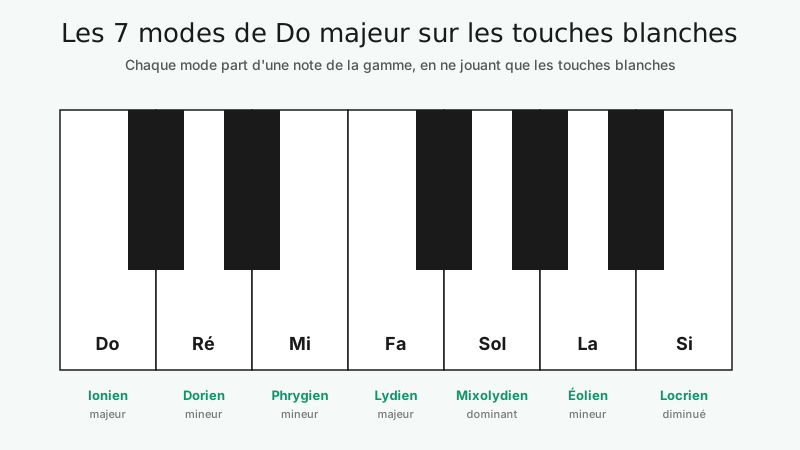
What is a mode of the major scale?
A mode is a scale that reuses exactly the same notes as a major scale, but changes the starting note. The C major scale contains C, D, E, F, G, A, B. Seven notes. So seven possible starting points, and therefore seven modes.
Why does it change anything if the notes are identical? Because the starting note becomes the center of gravity. Everything organizes itself around it. The intervals between that tonic and the other notes are no longer the same, and it is the arrangement of whole steps and half steps that creates the color. Move the center, and you move the mood.
It is exactly like looking at a painting and deciding that a particular corner is the subject. The painting doesn't move. Your attention does. The major scale is the painting, the mode is the point of view.
The 7 modes one by one: their sound and their chord
Each mode has a personality, and above all a chord that fits it naturally. That is what makes modes useful rather than theoretical: they tell you what to play over which chord. We'll take them in order, from C to B.
Ionian (C to C): the basic major
This is the major scale everyone knows. Joy, clarity, stability. Its chord: C major 7. Nothing mysterious here, it is the reference point from which the other six are defined.
Dorian (D to D): the jazz minor par excellence
The Dorian mode is minor, but with a major sixth that lights it up from below. The result: melancholic without being sad, sophisticated, slightly nostalgic. It is the mode of modal jazz. So What by Miles Davis (album Kind of Blue, 1959) holds eight whole bars on a single Dm7, in D Dorian, then climbs a half step into Eb Dorian. Maiden Voyage by Herbie Hancock works on the same principle. Its chord: minor 7.
Phrygian (E to E): the Spanish tension
Phrygian is minor too, but its minor second, that half step right on the second note, gives it an oriental, flamenco flavor that is instantly recognizable. Dark, tense, dramatic. You find it in the music of southern Spain and in metal. Its chord: minor 7, often treated as a sus b9 color.
Lydian (F to F): the dreamy major
Take a major chord and add an augmented fourth, that famous F-to-B tritone that floats. Lydian sounds brighter than the ordinary major, almost cinematic. It is the color of John Williams' film scores and of many Bill Evans ballads. Brighter than Ionian, more open. Its chord: major 7 #11.
Mixolydian (G to G): the dominant that grooves
Mixolydian is the major with a minor seventh. That lowered note removes the wisdom of Ionian and adds groove. Blues, funk, rock, jazz: as soon as a dominant chord (7) lingers, you are in Mixolydian. Norwegian Wood by the Beatles wanders around in it. Its chord: 7 (dominant).
Aeolian (A to A): the melancholic natural minor
Aeolian is simply the natural minor scale. Sad, introspective, darker than Dorian because it lacks that consoling major sixth. Stairway to Heaven, Losing My Religion: pop and rock are full of it. Its chord: minor 7.
Locrian (B to B): the unstable mode
Locrian is the black sheep. Its diminished fifth makes its very tonic wobbly, and its basic chord is a minor 7 flat 5 (half-diminished). It is hard to stay in, and it is rarely used as a main color. But over an m7b5 chord, for example the ii of a minor ii-V-I, it becomes the exact tool you need.
How to play the modes on piano without getting lost?
The white-key method is unbeatable for getting started, but it has a trap: you end up believing that Dorian is "the white keys starting on D." Wrong. Dorian exists in all twelve keys. D Dorian and G Dorian are the same mode, moved.
The real way to think about a mode is in relation to its tonic. Take the starting note, keep it fixed, and apply the formula of the mode. Dorian, for example, is a minor scale with the sixth raised a half step. Play C natural minor, raise the A-flat to A natural, and you have C Dorian. No need to think "Eb major moved."
Here is a concrete exercise that flips your understanding. Choose a single bass note, for example D, and hold it in the left hand. In the right hand, play in turn D Ionian, D Dorian, D Phrygian, D Lydian, D Mixolydian, D Aeolian, D Locrian. Same tonic, seven colors. You hear the color change one note at a time. It is the ear, not the brain, that learns the modes.
Why did the modes revolutionize jazz?
Until the late 1950s, improvising meant chasing a chord chart that flew past quickly, sometimes two chords per bar. Miles Davis had had enough. On Kind of Blue, he slowed the harmony down to one chord every eight bars, sometimes sixteen, and let the musicians explore a single modal color at length. So What is almost nothing but a Dm7 and an Ebm7. All the genius is in what Bill Evans, Coltrane and Cannonball Adderley do inside that space.
This approach, modal jazz, freed improvisation. Fewer notes to avoid, more room for melody and voice leading. Herbie Hancock pushed the idea further with Maiden Voyage, suspending the chords so that none really resolves. The listener floats. That floating is the sound of modes in action.
Understanding the modes also changes the way you read a standard. A Dm7 that lasts is no longer just "a minor chord." It is an invitation to enter Dorian. A Cmaj7 that stretches out becomes Lydian terrain if you raise the fourth. Chords are no longer boxes to fill, they are doors into colors.
Hear each mode under your fingers
HarmoniKeys does not display modes: it loops, at your tempo, the chord or progression that carries each mode (Dm7 for Dorian, Fmaj7 for Lydian...). Download HarmoniKeys, let the chord run and move from one modal color to another on top.
Open HarmoniKeysWhere to start, concretely?
Don't try to swallow all seven modes in a week. Start with Dorian and Mixolydian, the two most profitable. Dorian opens up the entire minor jazz repertoire, Mixolydian gives you the blues and funk sound over any dominant. Work them in two or three keys, in the right hand over a held bass note, until the color is familiar to the ear.
Then listen actively. Put on Kind of Blue and try to hear where So What tips from D to Eb. Spot the Lydian color in a film score. The ear progresses as fast as the fingers, sometimes faster.
When the modes start to speak, the rest of harmony lights up. Connect this work to voice leading on piano to link your chords cleanly, and to the ii-V-I progression to see where each mode falls right on the correct chord. Dorian on the ii, Mixolydian on the V, Ionian or Lydian on the I: everything ends up fitting together. To dig into the theory from the sources, the mode (music) page on Wikipedia details the Greek origin of the names.
Seven colors, one single scale. That is all. The day you hear them separately, you no longer play notes. You paint.