 Harmoni
Tap three even beats with one hand on the table. Easy. Tap four even beats with the other. Also easy. Now do both at once, over the same span of time. Suddenly the brain locks up. Welcome to the piano polyrhythm, the moment two speeds share your ten fingers and flatly refuse to line up.
3 against 4 has a reputation as the amateur pianist's brick wall. It isn't one. This is not about talent or some mysterious rhythmic gift: it's a grid to understand, a motion to automate, and two or three exercises to drill at the right tempo. We'll take the mechanism apart, hand by hand, then hear where the sound hides, from Chopin to Brad Mehldau's jazz.
What exactly is a polyrhythm?
A polyrhythm is two divisions of time overlaid that don't match up. The same span, say one beat of the bar, gets split into 3 on one side and 4 on the other. Both starts happen together, but after that nothing lands in the same spot until the cycle closes. That friction is what gives the music its roll, its float, that sense of a fabric breathing.
Don't confuse it with polymeter, which stacks two different bar lengths (a 4/4 and a 3/4, for instance). A polyrhythm lives inside a single pulse. On the page it's written as a ratio: 3:2 for three against two, 4:3 for four against three. The idea is ancient and universal, from West African drumming to the European classical repertoire, but on the piano it has a special flavor, because one brain drives both voices.
How do you play 3 against 4 on piano?
The key is one phrase: the lowest common multiple. Three and four meet on twelve. So you don't play "three on one side, four on the other" as two separate streams, which is impossible to control consciously. You play a single grid of 12 equal subdivisions, and you know in advance which subdivision each hand strikes.
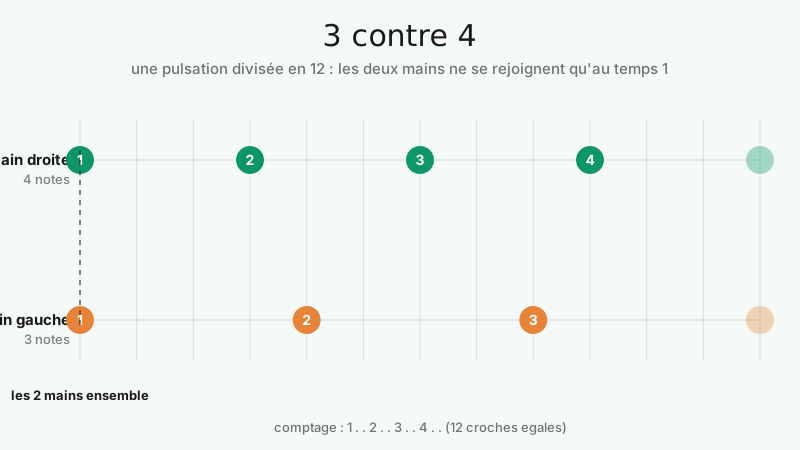
In practice, number the twelve subdivisions 1 to 12. The hand playing 4 lands on 1, 4, 7 and 10. The hand playing 3 lands on 1, 5 and 9. Count "1-2-3-4-5-6-7-8-9-10-11-12" very slowly, out loud, and drop each note into its slot. At first it's mechanical, almost robotic. That's normal. At this stage you're not hearing music yet, you're placing dots on a ruler.
The next step is the one that unlocks everything: forget the grid. Once the placement is reliable at a crawl, speed up gradually, and at some point the counting has to vanish. The brain flips and perceives the two streams as one motion, a pattern you feel instead of calculate. Many pianists keep a short phrase as a rhythmic crutch: people often chant "pass the bread and butter" to the shape of the 3 against 4, since its stresses land exactly where the notes fall.
Why start with 3 against 2?
Before 3 against 4 there's a simpler, far more common stepping stone: 3 against 2. Its grid is only 6 subdivisions. The hand of 3 hits 1, 3, 5; the hand of 2 hits 1 and 4. One offset to manage instead of two. It's the polyrhythm you hear the moment a right-hand triplet sits over two left-hand eighths, which happens in a wild number of romantic pieces and ballads.
The most common mnemonic for 3 against 2 is the phrase "nice cup of tea": said in rhythm, it naturally places both hands. Once 3 against 2 flows, 3 against 4 becomes a logical extension, not a mountain. Skip that step and you'll hit the wall; respect it and the progress comes easily. It's the same principle as hand independence in a walking bass: isolate each hand first, then interlock them.
Which exercises build hand independence?
Independence isn't declared, it's built in layers. Here's the progression that actually works, tested on students who swore they were "hopeless at rhythm."
1. Isolate each hand first
Play the hand of 4 alone with a metronome until it's perfectly even and, above all, unconscious. Then the hand of 3 alone, same thing. As long as either one still demands attention, overlaying them is impossible. A trick: keep one hand busy on an automatic motion while the other works, to prove to your brain that they can live apart.
2. Voice the composite grid
Recite the entries in chronological order. For 3 against 4: both hands together, then 4 alone, 3 alone, 4 alone, 3 alone, 4 alone, and back around. Tap that pattern on your knees, left and right, no piano. The keyboard comes later. Separating rhythm from pitch cuts the difficulty in half.
3. Loop very slowly, then speed up
Take two bars, loop them at a crawl for several minutes, then bump the tempo one notch only when it's clean. Evenness always beats speed. A slow, settled 3 against 4 is worth infinitely more than a fast, wobbly one. Swap the roles too: play 4 in the left and 3 in the right, because almost everyone has one hand more comfortable than the other, and the imbalance shows up fast.
Where do you hear polyrhythm on piano?
Everywhere, once you open your ears. Among the Romantics, Chopin turned it into a language. His Étude Op. 25 No. 2 lays eighth-note triplets in the right hand against quarter-note triplets in the left, creating a deliberate rhythmic blur, that gliding-mist feeling. His nocturnes are full of these offsets, where a long right-hand garland floats freely over a square left-hand accompaniment.
In jazz, polyrhythm is a tension tool. Overlaying a triple pulse on a 4/4, playing three over four in your comping, is what gives the groove its elasticity. Brad Mehldau made it a signature, his left hand setting one meter while the right stacks another. And polyrhythm reaches well past piano: Nine Inch Nails brings in a 4/4 drum beat against a piano in 3/4, and Kendrick Lamar's To Pimp a Butterfly plays with it too. Even Mozart had fun with it: in Don Giovanni he has two on-stage orchestras sound in different meters, 3/4 against 2/4.
The thread running through all of it: polyrhythm is never an idle exercise. It creates a precise emotion, a sway, a tension that resolves on the downbeat. That's exactly the spirit of modal improvisation, where a few simple elements are enough, as long as you listen to what they make together.
Feel the polyrhythm under your fingers
HarmoniKeys breaks rhythm and harmony down right on the keyboard, left and right hands shown, to move you from counting to feeling in just a few sessions.
Try HarmoniKeys3 against 4 is not an innate gift, it's a grid understood then forgotten. Start with 3 against 2, respect the slowness, isolate each hand, and let your ear take over from the math. One day, out of nowhere, the pattern starts turning on its own. The natural next move is to chase these floats in a real piece: open a Chopin nocturne or a standard, and hear how the greats fit two pulses into a single gesture.
About this article: written for pianists stuck on 3 against 4 who want a concrete method, from the beginner meeting the triplet to the jazz player stacking meters. Reference source: Polyrhythm (Wikipedia).